Custom Bag Sample Feedback: Writing Notes Your Sourcing Partner Can Act On
Most sample rounds are lost in translation rather than in sewing. A note that says the strap feels wrong cannot be actioned, while a note that says the left strap sits 12 mm higher than the right at the top root, see frame 3, can be corrected in a day. This article sets out how to write feedback that a production team can use: locate every observation by measurement and reference frame, classify severity so the important items are fixed first, photograph at the right distance with a scale object, consolidate everything into one round instead of four, and flag which changes move price and calendar. It ends with a template that works and the reply you should expect back.
- Why sample feedback fails
- The anatomy of an actionable note
- Locating a defect: coordinates not adjectives
- Severity: classify before you send
- Photographs that remove ambiguity
- One round or many: consolidating feedback
- Feedback that changes price and calendar
- The response you should expect back
- A feedback template that works
- Vocabulary that translates well
- From feedback to approved reference
Why sample feedback fails
A sample round is a conversation between two people who cannot see the same object. The creator holds the bag, turns it, loads it, carries it and forms an impression. The production team reads a message describing that impression and has to convert it into a machine setting, a pattern line or a component change. Every sample round that runs longer than it should has failed somewhere in that conversion, and the failure is almost always in the note rather than in the sewing.
Three specific habits cause most of it. The first is describing a feeling instead of a location. The strap feels bulky is a genuine observation and an unusable instruction, because bulkiness has ten possible causes: webbing width, webbing stiffness, edge finish, padding thickness, the fold at the top root, the adjuster hardware, or the angle at which the strap enters the panel. The second is sending notes in a stream over several days, so each one arrives after the previous one has already been interpreted. The third is mixing preferences with defects, so a change that costs nothing sits next to one that costs a pattern revision and the team cannot tell which is mandatory.
The cost is calendar, and calendar is the scarce resource in a campaign. Each additional feedback round costs a sampling window: 6-10 working days for a standard build, 12-15 working days for a complex one. A round that should have taken one pass and instead takes three has cost the campaign roughly a month before bulk production has even started, against a 35-50 day production window that follows. Creators feel that delay as an unresponsive supplier, when it is usually an unclear instruction.
There is also a quieter cost. When a note is ambiguous, the team makes its best interpretation and builds it. If the interpretation is wrong, the next round corrects it, and the correction often introduces a second change the creator did not ask for, because a pattern adjustment has knock-on effects. Two rounds later the bag is worse than it was at the start, and nobody can say why. Clear notes are not pedantry, they are prototyping programme hygiene.
The anatomy of an actionable note
An actionable note has five parts, and a note missing any one of them will generate a clarifying question. Writing all five takes about thirty seconds per observation and removes a round of email from the calendar. Once the habit is formed, a full sample review takes under an hour and produces a document the team can work from without interpretation.
- Location: where on the bag, by measurement from a stated datum, plus which panel or component.
- Observation: what is actually there, stated as a fact rather than as a judgement.
- Expected: what the specification or the campaign promise says it should be.
- Severity: must fix, should fix, or nice to have, with the reason.
- Reference: the frame number or the flag number that shows it, plus the specification line it relates to.
Writing the observation as a fact rather than a judgement is the part that feels unnatural and makes the biggest difference. The pocket is too shallow is a judgement. The front pocket opening measures 95 mm against 120 mm on the specification sheet is a fact, and it carries its own correction. The first version invites a debate about whether 95 mm is acceptable; the second resolves itself.
The expected field does the rest of the work. It converts a preference into a requirement and it prevents the most common dispute in sampling, which is whether a change was ever agreed. If the note says what the specification requires and the specification is a numbered document, then the correction is not a new request, it is conformance.
One practical rule follows from the five parts: write one line per observation. A paragraph containing four observations will be answered as though it contained one, because the team will fix the first thing it can identify and report back. Numbered lines get numbered answers, and the numbering is what lets you check that nothing was silently dropped.
Locating a defect: coordinates not adjectives
Location is where most notes fail, and bags are harder to describe than most products because they are soft, three-dimensional and symmetrical. The solution used in every technical specification is a datum: a fixed reference point from which measurements are taken. Agreeing three datums at the start of the programme makes every later note unambiguous.
| Datum | Defined as | Use for | Example note |
|---|---|---|---|
| Top edge | Highest point of the front panel | Vertical positions | Logo sits 60 mm below the top edge, spec says 45 mm |
| Centre line | Midpoint of the panel width | Horizontal symmetry | Pocket is 4 mm right of the centre line |
| Base seam | Where the base meets the front panel | Lower features | Feet are 18 mm from the base seam, not 25 mm |
| Strap root | Where the strap enters the panel | Attachment issues | Left strap root is 12 mm higher than the right |
| Inside lining seam | Interior bottom corner | Interior issues | Lining is loose along 60 mm at this corner |
Left and right need defining too, and the convention that avoids arguments is to name them from the wearer's perspective, as worn, rather than from the viewer's perspective looking at the front. A note that says the left strap is longer means opposite things depending on which convention is in use, and a symmetrical bag makes the ambiguity invisible until the correction comes back wrong.
For defects that are not positional, the equivalent of a datum is a count or a measure. Stitch density is counted over a stated length rather than judged. Zipper travel is described in cycles and in where it catches, measured from the stop. A colour issue is described by comparison with the approved reference under a stated light source rather than by naming a colour. Each of these converts a taste question into a measurable one.
The last location tool is the marked-up photograph, and it is the fastest of all. Print a frame, draw an arrow to the point, write the measurement beside it, and number it. A team that receives twelve numbered frames with measurements finds twelve items in one pass. A team that receives a paragraph describing twelve items will find the four it recognises. The CAD and specification route explains how these coordinates get into the document in the first place.
Severity: classify before you send
Severity is the part creators skip, and it is the part that decides how fast the round closes. Without it, the team treats every item as equally mandatory, which means a cosmetic preference triggers the same effort as a structural fault, and the sampling window is spent on things that did not matter. With it, the important items get the pattern time and the cosmetic ones get scheduled if there is room.
Three classes are enough. Must fix means the bag cannot be shipped or cannot match the campaign promise: a failed function test, a dimension that breaks a stated device fit, a wrong component, a decoration error. Should fix means the bag works but misses the intent: a pocket is usable but shallow, a strap is comfortable but stiff. Nice to have means a refinement that would improve the product and would not be noticed if it stayed.
- Must fix: fails a function test, breaks a stated claim, wrong component, decoration wrong.
- Should fix: works but misses the design intent, visible but not defective.
- Nice to have: refinement, invisible to backers, no functional effect.
- Question: not a change request, asks why something was done a particular way.
- Confirm: the item is correct, recorded so it is not changed by accident later.
The confirm class is underused and valuable. Most of a sample is correct, and saying so prevents the most demoralising outcome in sampling, which is a correction that fixes one thing and quietly changes three things that were already right. Listing the items that are approved tells the team to leave them alone.
The question class matters too, because it separates information-seeking from change-seeking. Asking why the base was built with a stiffener is not a request to remove it, and marking it as a question means the team answers in a message instead of rebuilding the unit. That single distinction removes a large share of unnecessary sampling rounds.
Severity also drives the honest conversation about cost. A must-fix is corrected at no commercial discussion, because the specification was not met. A nice-to-have that requires a new pattern is a commercial decision, and it should be raised as one: what does this change cost, and does it move the delivery date. Our campaign bag specialist answers those two questions explicitly for every non-mandatory item, because a creator cannot decide without them.
Photographs that remove ambiguity
A photograph is the fastest way to locate an issue and the easiest way to introduce a new one, because a badly lit, tightly cropped, unlabelled frame tells the team less than a sentence would. Four rules fix almost every problem, and none of them require a studio.
- Shoot one wide frame first so the team can see where on the bag the close frame sits, then the close frame.
- Include a scale object, ideally a ruler or a tape measure, in the same plane as the defect.
- Shoot in even daylight or under a single fixed light source, and say which.
- Number every frame and refer to the number in the note.
The wide-then-close rule is the one most often broken. A macro frame of a stitch irregularity is useless on its own, because the team cannot tell whether it is on the front panel, the base or the strap. Adding a wide frame with a small marker at the location costs one second and removes the guess entirely.
Scale is the second failure. A photograph of a gap, a wrinkle or a misalignment has no size reference, so the team cannot tell whether it is looking at 2 mm or 20 mm, and those have completely different corrections. Putting a ruler in the frame, at the same distance and in the same plane, makes the frame measurable.
Video is worth using for two specific categories and not for others. A zipper that catches, a strap adjuster that slips, a buckle that is stiff to release and a lining that bunches when the bag is loaded are all movement problems, and a five-second clip communicates them in a way no still frame can. Colour, dimensions and finish are still-frame problems, where video adds nothing and often misleads.
The one thing never to do is send a photograph with a filter or an automatic colour enhancement applied. Phone processing shifts colour and contrast, and a colour note built on a processed image will be corrected against a colour that was never there. Send the original file and, if the note is about colour, include the approved physical reference in the same frame under the same light.
One round or many: consolidating feedback
The single highest-leverage change a creator can make to their sampling process is to send one consolidated round instead of a stream of observations. Each consolidated round costs one sampling window. A stream of observations arriving over five days usually produces two windows, because the team starts work on the first batch and then has to restart for the later ones.
Consolidation requires a short discipline. Receive the sample, do nothing for a day, then run a structured review in one session: exterior, interior, hardware, closures, decoration, dimensions, function, and comparison with the campaign promise. Write every note during that session, including the confirmations. Then send once.
| Approach | Rounds needed | Sampling windows | Typical calendar cost |
|---|---|---|---|
| Notes over five days | 2-3 | 2-3 x 6-10 working days | Several weeks added |
| One consolidated round | 1 | 1 x 6-10 working days | One window |
| Consolidated, complex build | 1 | 1 x 12-15 working days | One longer window |
| Consolidated with a pattern change | 1-2 | 2 windows | Added before bulk |
| Streamed with a pattern change | 3-4 | 3-4 windows | Can exceed the bulk window |
The review session itself benefits from a second person. One person reads the specification aloud while the other holds the bag and checks each line, because reading a specification alone tends to produce agreement, while reading it to someone who is looking at the object tends to produce findings. Campaigns that adopt this two-person check typically find several items they would otherwise have discovered only in bulk.
There is one legitimate exception to consolidation: a safety or function failure found during the review should be flagged immediately, because it may affect how the rest of the review is interpreted. A strap that fails a load test changes what is worth noting about the strap attachment. Flag it, then continue and send the consolidated round with it at the top.
Consolidation also makes the commercial conversation cleaner. One round with fourteen numbered items can be answered with fourteen numbered responses, including cost and calendar implications per item. Four separate messages cannot be summarised that way, and something is always lost between them.
Feedback that changes price and calendar
Not all feedback is equal in cost, and knowing which class an item falls into before sending it lets a creator decide whether to ask. Four classes cover most cases: setting changes, component changes, pattern changes and construction sequence changes. The first two are usually cheap, the third is moderate, and the fourth can be substantial.
- Setting change: machine tension, stitch density, press temperature, jig position. Cheapest, same-day.
- Component change: a different zipper gauge, puller, buckle or webbing. Priced per component, may need sourcing time.
- Pattern change: a revised panel, a moved pocket, a changed capacity. New pattern and markers, adds a sampling window.
- Sequence change: a different assembly order. Can change the line layout and is the most expensive class.
- Material change: a different fabric, weight or coating. Re-costs the unit and may re-open the MOQ question at 500 pcs per style and per colourway.
The MOQ interaction is worth stating plainly. A material change on one colourway can re-open the minimum question, because a colourway is a coordinated set and a new fabric has to be available in the quantity needed. Asking for a different shell fabric late in sampling is not a small request, and it is better raised as a question with a cost attached than as an instruction.
The calendar interaction works the same way. A setting change costs nothing. A component change costs sourcing time, which may be days or weeks depending on whether the item is stocked. A pattern change costs a full sampling window of 6-10 working days, or 12-15 for a complex build, and it delays the start of the 35-50 day bulk window. Asking which class an item falls into before requesting it is the cheapest planning question in the whole programme.
A useful habit is to add a column to the feedback sheet headed cost and calendar, left blank, and ask the team to fill it. The reply then arrives as a decision table rather than as a narrative, and the creator can approve the expensive items and drop the ones that are not worth a window. Our programme coordinator returns feedback in exactly that form, and it is the reason sampling lead times stay predictable.
The response you should expect back
A good response to a feedback round mirrors the structure of the request. It answers item by item, in the same numbering, and for each item states what will change, whether it affects price, and whether it affects the calendar. A response that does not do this is a signal that the round will need another pass, and it is worth asking for the mirrored version rather than accepting a summary.
The response should also distinguish acceptance from interpretation. If an item is accepted as a specification failure, it is corrected at no commercial discussion. If it is accepted as a refinement, the response should say what it costs. If it is declined, the response should say why in technical terms: the material cannot hold that seam, the hardware is not available in that finish, the change would break a stated capacity. A decline without a reason is not acceptable.
Photographic confirmation of each correction is the last thing to expect. The rebuilt unit should arrive with a frame for each item that was changed, in the same numbering, so the creator can verify without having to re-derive what to look for. Campaigns that insist on this close rounds in one pass instead of two, and the images become part of the approval record.
The final expectation is a revised specification. Corrections that are not written into the specification document get lost at bulk, because the line builds from the document rather than from the conversation. Ask which revision number the corrections will be recorded against, and confirm that number before the unit is rebuilt. That single question prevents the most frustrating outcome in sampling: a perfect corrected sample followed by a bulk lot built to the old revision.
A feedback template that works
A template removes the friction from writing notes and makes rounds comparable across samples. The structure below is deliberately minimal: enough fields to be actionable, few enough that it gets used. It can be a spreadsheet, a document or an email, provided the numbering is stable and each item is one line.
| Column | Content | Example entry |
|---|---|---|
| Item | Sequential number | 07 |
| Location | Datum, panel, measurement | Front panel, 60 mm below top edge |
| Observation | Fact, not judgement | Measured 60 mm, specification says 45 mm |
| Expected | What the spec requires | 45 mm from top edge, revision 3 |
| Severity | Must, should, nice, question, confirm | Must fix |
| Reference | Frame or flag number | Frame 07a, 07b |
| Response | Left blank for the team | Filled by the production team |
Add three header fields above the table: sample identification, specification revision number, and date received. Those three make the sheet a record rather than a message, and they are what lets a later dispute be resolved by looking something up instead of by remembering it.
A short covering paragraph in front of the table helps more than it seems. State which items are mandatory, which are open to discussion, and whether the creator is willing to accept a calendar change for any of them. That paragraph tells the team how to prioritise when two items conflict, which happens more often than creators expect.
The template also scales down. For a one-item round, a single message with location, observation, expected, severity and a frame works fine. The point of the full table is not formality, it is completeness: the moment a round has more than three items, memory stops being reliable and the table starts paying for itself.
Vocabulary that translates well
Some words travel well between a creator and a production team and some do not. The ones that travel well are attached to a measurement, a reference or a standard. The ones that travel badly are attached to a feeling. Replacing the second group with the first is the fastest improvement most creators can make to their sampling process, and it requires no technical training.
| Instead of | Write | Why it works |
|---|---|---|
| Too small | Measures 95 mm against 120 mm on spec | Conformance, not opinion |
| Feels cheap | Webbing is 20 mm against 25 mm specified | Named component and figure |
| Looks off-centre | 4 mm right of the centre line | Measurable from a datum |
| Not sturdy enough | Fails at 8 kg load, spec states 12 kg | Testable condition |
| Colour is wrong | Shade differs from approved reference under D65 | Compared with a reference |
| Bulky | Padding is 8 mm against 5 mm specified | Cause identified |
| Zipper is sticky | Catches 40 mm from the stop on a filled bag | Reproducible location |
Note that the right-hand column does not require the creator to know the cause. It requires the creator to describe what is observable. Diagnosing the cause is the production team's job, and a precise observation lets them diagnose it in one pass rather than three.
Two words deserve special mention because they mean something specific in a bag specification and are often used loosely. Tolerance is the permitted variation around a stated dimension, and without it no dimension is decidable. Hand is how a fabric feels, and it is a legitimate specification item, but only when attached to a reference sample rather than to an adjective.
Finally, avoid comparative words unless the comparison object is named. Bigger, tighter, softer and darker are all meaningless without a reference. Attach them to the approved sample, to the specification figure or to a previous revision, and they become usable. Our team reads feedback for exactly these anchors, and notes without them are the ones that generate clarifying questions.
From feedback to approved reference
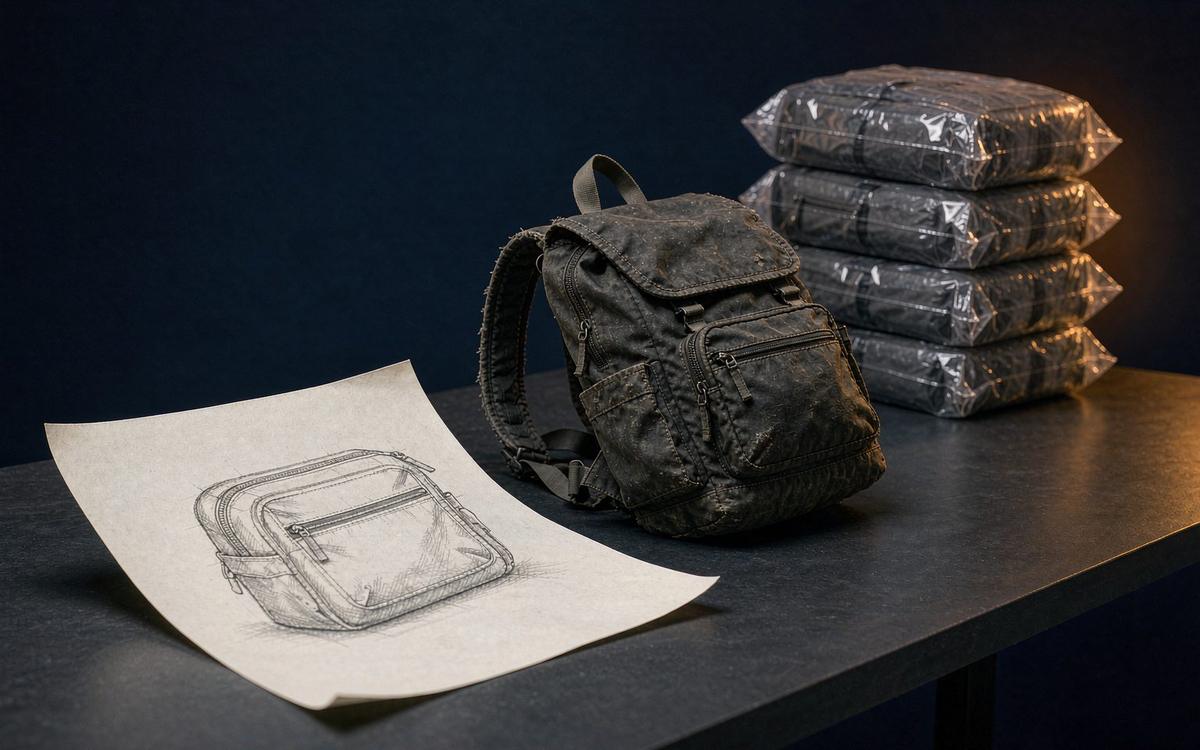
The end of sampling is not a feeling of satisfaction, it is a document. When the final round closes, the corrected unit becomes the approved reference, the specification is issued at a new revision number, and both are recorded. Everything downstream, including the pre-production check and the bulk inspection at AQL 2.5 to ISO 2859-1, is judged against that pair.
The transition has three steps and skipping any of them creates a gap that shows up months later. First, confirm in writing that the unit is approved and record which revision it represents. Second, retain the physical unit rather than shipping it, so there is something to compare against. Third, make sure the campaign page still matches the approved bag, because feedback rounds often change details the page is still promising.
The page check is the step most often missed and the one that produces the worst outcome. A sampling round that reduces a pocket depth by 20 mm for construction reasons is a sound engineering decision, but if the page still shows the original depth and a backer buys on that image, the campaign has a promise problem rather than a production problem. Our programme coordinator raises this explicitly at approval, and it costs a page edit rather than a refund wave.
After approval the programme moves into the 35-50 day bulk window, with deposit and balance under T/T 30/70 and FOB Xiamen terms. The feedback file travels with it, because any question during production is answered by reference to what was agreed. A clean feedback process produces a clean file, and a clean file is what makes a re-order repeatable rather than approximate.
Have a sample on your desk and a list in your head? Send the photographs, the measurements and the specification revision through the contact quotation form and we will return an item-by-item response with cost and calendar for each.
Frequently Asked Questions
How should I write feedback on a custom bag sample?
Use five parts per item: location by measurement from a stated datum, the observation as a fact, what the specification requires, a severity class, and the frame number that shows it. One line per item, numbered. That structure removes the interpretation step that causes most extra sampling rounds, and it lets the team reply item by item.
Why does my sample take so many rounds?
Usually because notes are ambiguous or arrive in a stream over several days. Each ambiguous note generates a clarifying question or a wrong correction, and each streamed batch restarts work that has already begun. Consolidating into one numbered round typically saves a full sampling window of 6-10 working days, or 12-15 for a complex build.
How do I describe where a problem is on a bag?
Agree three datums at the start of the programme: the top edge of the front panel, the centre line of the panel width, and the base seam. Measure from a datum and name the panel, and define left and right as worn rather than as viewed. For non-positional issues, use a count or measure: stitch density over a stated length, zipper catch distance from the stop.
What severity classes should I use in sample feedback?
Three are enough. Must fix covers anything that fails a function test, breaks a stated claim, uses a wrong component or has a decoration error. Should fix covers items that work but miss the intent. Nice to have covers refinements backers would not notice. Add confirm for items that are correct, so they are not changed by accident.
Should I send photos or video with my feedback?
Both, for different categories. Use still frames for colour, dimensions and finish, always with a wide frame first to locate the close frame and a ruler for scale. Use short video for movement problems: a zipper that catches, an adjuster that slips, a buckle that sticks, or a lining that bunches when loaded.
How many photographs should a sample review include?
Plan for two per issue: one wide frame showing where on the bag the problem sits, and one close frame with a ruler in the same plane. Number every frame and refer to the number in the note. Send the original file rather than a filtered one, because phone processing shifts colour and contrast.
What feedback changes the price?
Setting changes such as tension, stitch density or jig position are usually free. Component changes are priced per item and may need sourcing time. Pattern changes need new patterns and markers and add a sampling window. Material changes re-cost the unit and can re-open the minimum question at 500 pcs per style and per colourway.
What feedback changes the delivery date?
Anything that needs a new pattern, a new material or a new component. A setting change costs nothing, while a pattern change adds a full sampling window before the 35-50 day bulk run can start. Ask which class an item falls into before requesting it, or add a cost and calendar column to the sheet and let the team fill it in.
Should I send feedback as I notice things or all at once?
All at once. Run one structured review session covering exterior, interior, hardware, closures, decoration, dimensions, function and the campaign promise, then send once. The single exception is a safety or function failure, which should be flagged immediately because it may change how the rest of the review is interpreted.
What response should I expect to a feedback round?
A mirrored reply: item by item in the same numbering, stating what will change, whether price is affected and whether the calendar moves. Expect photographic confirmation of each correction, and confirm which revision number the corrections are recorded against so bulk is not built to the previous version.
Can I approve a sample verbally?
It is possible but inadvisable. Approval releases the material lot, starts the 35-50 day production clock and triggers the deposit structure under T/T 30/70. Record the approval in writing with the sample identification, the specification revision and the date, and retain the physical unit as the reference.
How do I check my campaign page still matches the approved bag?
Walk the page against the approved specification after every feedback round, because rounds often change details the page still promises. A pocket reduced by 20 mm for construction reasons is sound engineering, but if the page still shows the original depth the campaign has a promise problem rather than a production problem.
People Also Ask
What is an actionable sample note?
One line per observation with location by measurement, the fact, the expected value, a severity class and a frame reference.
How do I say a strap feels wrong?
Measure it instead: webbing width, padding thickness, root position difference between left and right, with a frame for each.
Should I mark the sample itself?
Yes. Numbered sticky flags or tape markers on the bag, matched to numbered frames, are faster and clearer than any written description.
What is a datum in bag feedback?
A fixed reference point for measurement, typically the top edge, the centre line or the base seam of the front panel.
How fast should a feedback response arrive?
Within the working day for the response, and within one sampling window of 6-10 working days for the rebuilt unit.
Is it rude to mark items as must fix?
No, if the item genuinely fails a function test or a stated claim. Severity saves the team from guessing what matters.
What if the team declines a change?
Ask for the technical reason. A decline without a reason is not acceptable, and the reason usually points at a workable alternative.