Crowd Supply Bag Rewards: A Hardware Niche Platform Guide
Crowd Supply is a hardware niche platform, so a bag on it is almost never the hero product. It is a carrying solution for a device: a travel case, a field pouch, a cable roll or a transport shell for the thing the campaign actually funded. That single fact changes the brief, the quantity, the fit tolerance and the timeline. The minimum stays at 500 pcs per style and per colourway, sampling runs 6 to 10 working days, and bulk production takes 35 to 50 days, all of which has to be reconciled with a hardware development calendar that slips more often than a bag calendar does. This guide covers the fit problem, the material choices that matter around electronics, the tooling costs nobody budgets, and how to price a case as an add-on rather than a hero reward.
- What a Crowd Supply campaign actually is
- Why the bag is an accessory, not the hero
- The quantity collision with 500 pcs
- One device, several carrying formats
- Fit is the product: tolerancing a case
- Materials for carrying electronics
- Tooling and the fixed costs nobody budgets
- Timeline when the hardware slips
- Pricing the case as an add-on
- Open-source audience expectations
- A pre-launch checklist for hardware-niche bags
What a Crowd Supply campaign actually is
Crowd Supply occupies a different position from the general-interest crowdfunding platforms. The catalogue is built around physical objects that require real engineering to make: single-board computers, mechanical keyboards, open-source test equipment, small radios, sensors, modular computing devices and repairable consumer electronics. The audience arrives with a particular expectation. They read specification sheets, they ask about tolerances and certification marks, they want to know what the enclosure is made of, and they treat a vague answer as a warning. A bag campaign that appears alongside that catalogue has to speak the same language, or it will look like it wandered in from a different room.
The commercial mechanics differ too, and they matter to a bag budget. Platform fees on Crowd Supply are typically around 5 percent of funds raised, with payment processing typically adding a further 3 to 5 percent depending on the method and the backer's card, but every creator should check current platform terms before locking a budget, because these figures move and the split between platform and processor is not the same on every campaign. The practical consequence is that an add-on priced at 39 USD does not leave 39 USD of production money. After fees, the realistic production and freight envelope is materially smaller, and the case has to be designed to that number from the first sketch rather than trimmed into it later.
There is also a post-campaign shop. Many hardware projects continue selling units after the funding period closes, which means the case you designed for 600 backers can keep generating orders for a year or longer. That is the strongest argument for spending money on the specification rather than on the first sample. A retained and approved reference sample, a stable pattern file and a written material call-out hold their value across every future run, while a sample that was approved on a phone photo tends to cost more the second time it is needed. Our team has supported more than 20 crowdfunding campaigns, and the projects that treat the packaging or carrying item as a durable asset are the ones that reorder cleanly. If you want the wider platform context, the Indiegogo and cross-platform bag guide covers how a second platform changes the same decisions.
Why the bag is an accessory, not the hero
On this kind of platform the funded object is the device, and everything else exists to make the device usable, portable or storable. That is not a lesser role, but it is a different one, and it changes how the product should be briefed. A hero bag is sold on looks, capacity and lifestyle. A device case is sold on three things: it must close around the object without forcing it, it must protect the object from the specific hazards it will meet, and it must not interfere with using the object. Everything else, including colour, is secondary. Creators who brief a device case as though it were a lifestyle backpack end up with a beautiful product that does not quite fit the revision of hardware they are shipping.
The second consequence is that the accessory has to be specified against a device that is still moving. Hardware revisions change. A board grows a connector, a case gains 2 mm, a keyboard adds a rotary encoder, and the pouch that fitted revision 0.9 is now 3 mm too tight. This is the central engineering risk of a hardware-niche bag programme, and it is not solved by making the bag bigger. A loose case allows the device to move, and movement is what damages connectors, screens and protruding boards. The objective is a controlled fit with a stated tolerance, not a generous one.
The third consequence is about how the accessory is presented. On a general platform, a bag reward is a tier. On a hardware platform, the case is usually an add-on priced alongside the device, or a bundle component at a higher tier. That puts it under a different margin discipline. An add-on competes for the backer's remaining budget after the main purchase, so it has to justify itself quickly and it has to be priced against what the same backer could buy from an established accessory brand. The realistic defence is not price. It is that the case was designed for this exact device, and a generic case was not.
The quantity collision with 500 pcs
Hardware campaigns frequently fund in the range of 300 to 1,500 units, and the accessory rarely sells to every backer. A case that goes to 40 percent of a 900-unit device campaign is a 360-unit bag order, and the minimum is 500 pcs per style and per colourway. That collision is the single most common structural problem in this niche, and it is better solved on paper before launch than in a negotiation afterwards. There are four ways out, and they have very different costs.
- Pool the formats. Treat two or three carrying formats as one style family in one colourway so the combined quantity clears the minimum, then differentiate with trim and labelling.
- Reduce the colourways. One body colour with two webbing or zip-tape colours usually reads as two products to a backer while consuming one colourway of shell fabric.
- Commit to the post-campaign shop. Count the shop as a genuine second channel and place the first order at 500 pcs, then reorder against real demand rather than forecast demand.
- Sell the case as a standalone SKU. A case sized for a popular device form factor has a market beyond the campaign, and that market can absorb the difference.
The pooling option deserves a note of caution. Pooling formats only works if the formats genuinely share a bill of materials, because the minimum is applied per style, and a style is defined by its construction, not by its name. A 2 mm neoprene sleeve and a 6 mm EVA moulded shell are two styles even if they carry the same device, and they will not pool. What does pool is the same shell construction in one fabric with different interior layouts, or the same shell in one colourway offered at two sizes. Define the style boundary with your sourcing partner before you promise a range to backers.
| Approach | Quantity effect | Cost effect | Best when |
|---|---|---|---|
| Format pooling in one colourway | Combines 2 to 3 SKUs into 1 minimum | Lowest unit cost of the four options | The formats share a shell construction |
| Trim and tape differentiation | 1 colourway, several visible variants | Adds a small trim handling cost | Visual range matters more than structure |
| Commit to the post-campaign shop | Absorbs 100 to 300 units over time | Carries holding and re-order cost | The device will keep selling for a year |
| Standalone retail SKU | Absorbs volume outside the campaign | Needs its own packaging and labelling | The device form factor is standard |
| Order above demand | Meets the minimum immediately | Ties up cash in dead stock | Only when the shop demand is proven |
The row to avoid is the last one. Ordering 500 pcs against a 300-unit demand without a credible route for the remaining 200 units converts a production decision into an inventory problem, and inventory problems in this niche are slow to resolve because the device itself may be superseded. If the demand genuinely is 300 and there is no second channel, the honest move is to say so early and price the accessory to make 500 units viable, or to drop it and offer a digital alternative. Our programme coordinators would rather decline a 300-unit case order than watch a creator sit on 200 of them.
One device, several carrying formats
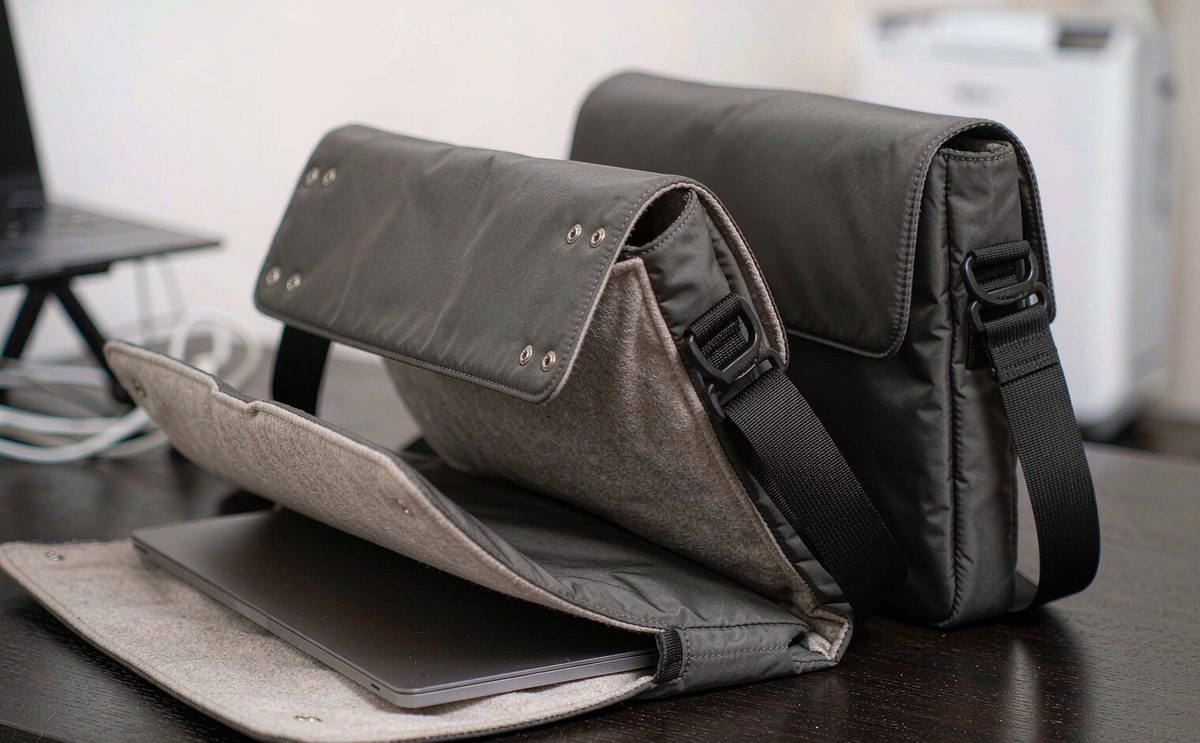
A single device can be carried several ways, and the choice is not cosmetic. The four formats that recur in hardware campaigns are the flat sleeve, the moulded shell case, the organiser pouch and the field roll, and each carries a different construction, a different tooling requirement and a different unit cost. The sleeve is the cheapest and the fastest to sample. The moulded shell is the most protective and the slowest, because it needs a mould. The organiser pouch is the most useful for accessories and cables. The field roll is the most distinctive and the most labour-intensive.
Sleeves suit flat objects: tablets, keyboards, solar panels, flexible displays and anything whose largest dimension is two-dimensional. A sleeve in 3 mm neoprene or a laminated EPE sandwich is quick to pattern, uses no tooling and can be sampled inside the standard 6 to 10 working days for simple constructions. Moulded EVA shells suit objects that will be dropped: test equipment, cameras, drones, handheld consoles. The shell carries impact, the interior carries organisation, and the whole assembly costs several times a sleeve. Organiser pouches suit the accessory layer: cables, probes, adapters, batteries and the small parts that otherwise go missing. A field roll suits tools and long thin items.
The decision should be driven by the dominant hazard, and naming the hazard explicitly in the brief is the most useful thing a hardware creator can do. Drop is a different problem from crush, crush is different from scratch, and water is different again. A moulded shell answers drop and crush. A padded sleeve answers scratch and light knock. A coated nylon organiser with a water-resistant zip answers rain. Trying to answer all four in one product produces an over-built case that costs more than the backer will pay, so pick the two hazards that actually apply and say so on the campaign page. Naming a limit is more persuasive to this audience than claiming everything.
Fit is the product: tolerancing a case
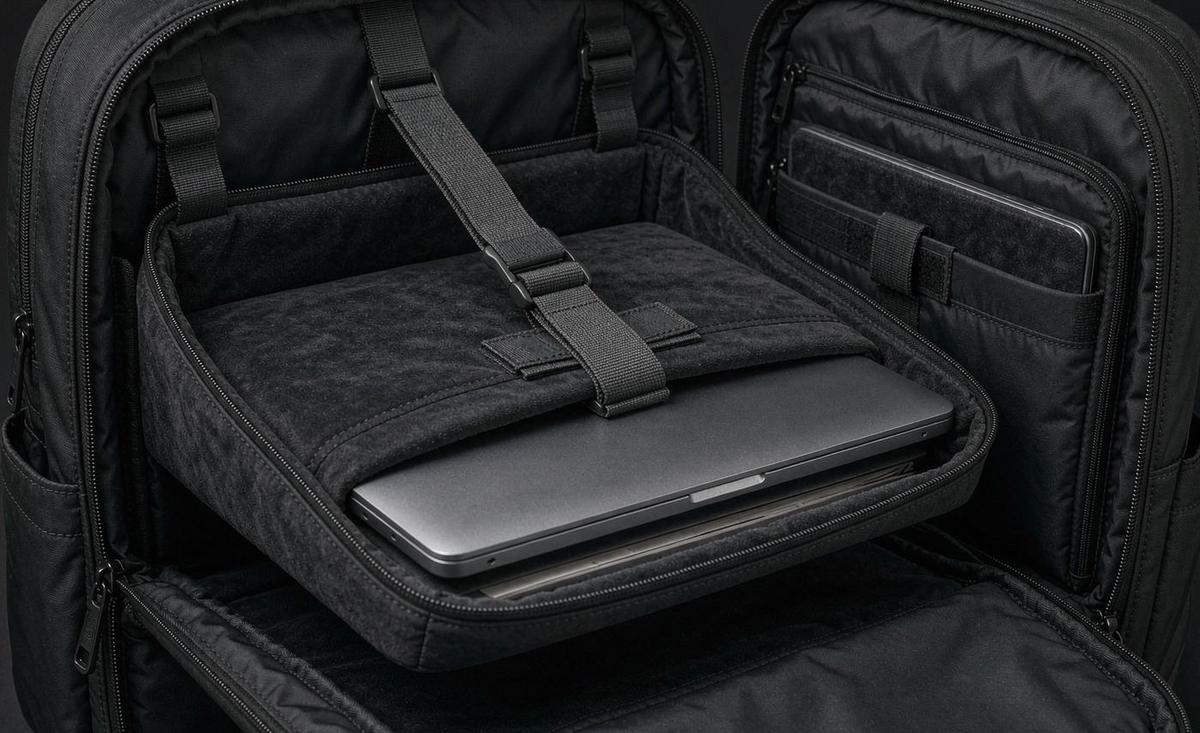
Fit is where hardware-niche bag projects succeed or fail, and it is a measurement discipline rather than a design instinct. A usable case specification states the device envelope in three dimensions, states the clearance allowed on each, and states what happens to the fit if the device changes. For a padded sleeve, a total clearance of 2 to 4 mm on the width and height is typically workable, because the padding compresses and the fabric relaxes. For a moulded shell, the equivalent figure is usually 1 to 2 mm, because a moulded cavity does not give. Those are working ranges for planning, not guarantees, and the right number depends on the pad density and the shell draft angle.
The second fit discipline is the revision freeze. A hardware project will have a revision at which the enclosure is stable, and the bag pattern must be cut to that revision, not to an earlier one and not to an aspiration. The practical method is to obtain two physical production-equivalent devices, or two accurate printed blocks, and to keep one on the production floor and one in your own office as a permanent reference. Every subsequent fit check is made against those objects. When the device changes, the blocks are reprinted and the pattern is re-cut. This costs a little time and prevents the most expensive mistake in the niche, which is 500 cases that fit a device that no longer exists.
The third discipline is the fit test itself, and it needs to be written down and repeatable. A fit test states the device, the orientation, the number of repetitions, and the pass condition. An example: the device is inserted and removed 50 times with its accessories attached; the pass condition is no deformation of the case mouth, no stitch failure at the stress points and no marking on the device. That is a test a production team can run on a first article and again on a bulk sample. For construction detail that affects fit, the bag construction techniques reference explains how boxed corners and seam allowances change internal dimensions.
Materials for carrying electronics
Electronics impose three material requirements that a fashion bag does not have: controlled abrasion, controlled moisture and, in some cases, static management. Abrasion control is about the lining. A coarse woven lining will mark an anodised surface over a few hundred cycles, so the interior of a device case normally uses a brushed tricot, a fine woven polyester or a velvet-finish lining. The lining specification is the cheapest upgrade in the whole product and the one most often skipped. Moisture control is about the outer shell and the closure. Where the fourth hazard in the previous section included rain, the answer is a coated shell with a water-resistant zip rather than a thicker fabric.
Static management is the requirement creators overestimate. Very few consumer devices need a conductive or antistatic bag during ordinary transport, and a fully antistatic build costs more, limits fabric choice and almost never appears on a campaign page as a benefit a backer understands. Where static matters is in shipping and storage of bare boards, and in that situation the correct answer is usually a separate antistatic liner or pouch inside a normal case, not a static-safe case. Ask for it when the object being carried is an unenclosed board. Do not ask for it when the object is a finished product in its own enclosure.
Padding is the material decision with the widest cost spread, and it should be chosen by hazard rather than by habit. EPE foam in 3 to 5 mm is the default for sleeves and light pouches, cheap and light, and adequate against scratch and knock. EVA in 4 to 8 mm, either sheet or moulded, is the answer against impact and holds shape better. Die-cut or moulded inserts are a step above both and are the correct choice when the device has protruding parts that must not be loaded. Costs rise in that order, and the rise is visible in the unit price, so the padding call should be made in the same meeting as the target price and not after it. For the foam and padding comparison, see the padded bag materials reference.
Tooling and the fixed costs nobody budgets
A hardware creator understands tooling better than most, because the device itself has almost certainly needed some. The bag still catches people out, because the tooling items in a bag programme are small, several, and rarely quoted as a single line. The list typically includes a moulded EVA shell mould if the format needs one, a die-cut tooling set for foam inserts, a cutting die for repetitive panel shapes, an embossing or debossing plate for any logo applied by heat and pressure, a silicone or PVC label mould if the badge is rubber, and a jig for any operation that must be repeated consistently across 500 units. Each is a separate purchase with a separate lead time.
The budgeting discipline is to request them as separate lines in the quotation and to ask two questions about each: what is the one-off cost, and what happens to it. Two things can happen and they are not equivalent. The tooling may be a genuine one-off development cost that remains the property of whoever paid for it, in which case it can in principle be moved; or it may be amortised into the unit price, in which case the unit price falls as quantity rises and the tooling is effectively being paid for across the order. Neither arrangement is wrong. Both need to be in writing before the deposit is paid, and the ownership of the physical tool needs to be stated as well.
The jig is the item most often missed, and it is the one most closely tied to consistency. A jig holds a panel, a strap or a badge in the same place for every unit, and without it the placement tolerance across 500 units is set by the operator's eye. Where a bag has a printed logo, a badge or a pocket that must sit in the same place on every unit, a jig converts a variable into a fixed one. It costs modestly and it reduces the defect rate in the operation it serves. If a quotation includes no jig and the product has a visible placement requirement, ask what is controlling the placement. The answer should be a physical thing, not a person.
Timeline when the hardware slips
Hardware slips. It slips for reasons that are sometimes avoidable and often not: a component allocation moves, a certification body takes longer than planned, a firmware fix lands late, a container waits. The bag programme has to be planned on the assumption that it will, because a case that arrives before the device is a storage cost and a case that arrives six weeks after the device is a support cost. The correct sequencing is not to start the bag when the device is finished. It is to start the bag when the device enclosure is frozen, which is usually earlier, and to hold the bulk slot without releasing it until the device date is credible.
Concretely, that means three things in writing. First, sample the case against a production-equivalent block rather than waiting for a finished device; the standard sample lead time is 6 to 10 working days, and 12 to 15 working days for complex constructions such as moulded shells with die-cut inserts. Second, place the bulk order on a provisional date with a stated release condition, and accept that the 35 to 50 day bulk lead time begins on release, not on the date the order was discussed. Third, keep the shipping method undecided for as long as possible, because the choice between sea and air is the main lever available when a date tightens and it is much cheaper to decide it late than to change it late.
| Stage | Trigger | Duration | What protects the date |
|---|---|---|---|
| Envelope specification | Enclosure revision frozen | 1 to 2 weeks | A written three-dimension envelope with tolerances |
| Prototype sampling | Envelope agreed | 6 to 10 working days | Fit test against a printed block, not a drawing |
| Complex format sampling | Moulded shell or die-cut insert | 12 to 15 working days | Tooling ordered before the sample round |
| First article check | One finished pre-production unit | 1 week | A repeatable fit and drop test, written down |
| Bulk production | Device date credible | 35 to 50 days | A provisional slot with a written release condition |
| Freight to backer | Goods packed | Varies by mode | Deciding sea versus air as late as the date allows |
The release condition is the part worth insisting on. A production slot held without a condition will eventually be released by someone's optimism, and the result is finished cases waiting for a device that has moved again. A production slot held with a written condition is released by evidence, which is slower and safer. If your device date moves by three weeks, three weeks of the 35 to 50 day window can usually be absorbed by freight choice and by packing sequencing, and the conversation about it should happen with the production team as soon as the slip is known rather than at the point the goods are ready. For the wider timing picture, the bag campaign delivery date guide covers what to promise backers and when.
Pricing the case as an add-on
An add-on has a different pricing logic from a tier. The backer has already committed to the device, so the case is competing for discretionary money, and the decision is made quickly on two inputs: the price and the fit claim. The price has to survive fees, unit cost, packaging and a share of freight. Working backwards is the only reliable method. Start from what a backer will pay for a case for this device, remove the platform and processing percentages, remove packaging and inbound freight, and whatever remains is the ceiling for the unit cost at your intended quantity. If that ceiling is below the cost of the format you want, either the format changes or the add-on does not happen.
Quantity is the strongest lever in that arithmetic, and it is a lever the minimum already forces you to pull. A case at 500 units and the same case at 1,500 units are not the same product economically, because the tooling, the sampling and the pattern work are spread over three times as many units and the fabric is bought in a larger lot. This is the argument for designing the case to sell beyond the campaign. If the device will have a post-campaign shop, if the case fits a common form factor, or if it can be sold to owners of an earlier revision, then the marginal value of each additional 500 units is real, and the add-on price can be set against a larger run.
The third pricing consideration is the bundling decision. A case offered only as an add-on at, say, 39 USD competes directly with every generic case a backer can find. The same case bundled into a higher device tier at a stated premium reads as part of the product and converts differently. Most hardware campaigns do both: the case appears at around 39 USD as a standalone, and it appears inside a bundle at a price that is not directly comparable to the standalone. There is no rule that says which should carry the margin. There is a rule that says the standalone price has to be defensible on its own, because that is the number a backer will check.
Open-source audience expectations
The hardware-niche audience behaves differently from a general consumer audience in three specific ways that a bag page can either satisfy or offend. They read material call-outs, they check whether a claim is measurable, and they notice when something is described in marketing language rather than specification language. A case described as military-grade and indestructible will be read as a case with no published test. A case described as a 5 mm EVA shell with a brushed tricot lining and a YKK coil zip, tested to 1,000 insert and remove cycles, will be read as a product the creator understands. Same object, two entirely different receptions.
The second expectation is about documentation and openness. This audience publishes its own files, and it notices when a project is cagey about what things are made of. Naming the materials, the hardware brands and the construction method is cheap, costs nothing commercially, and reads as competence. It also has a practical benefit: when a backer later asks for a replacement part, a named zip and a named fabric are things that can be sourced, and an unnamed one cannot. For the same reason, this audience responds well to a case that can be repaired, with a replaceable zip slider and a standard puller, and poorly to one that is permanently bonded.
The third expectation is about the limits. An audience that builds things knows that nothing is waterproof, nothing is indestructible and every material has a failure mode. Stating the failure mode is a credibility gain, not a loss. A case that says it will protect a device from a 1 m drop onto a hard floor, and that it is water-resistant rather than submersible, has made two claims that can be true. One that says it protects against everything has made a claim that cannot. If the device is going into an environment where that matters, the waterproof fabric and seam-sealed construction guide sets out what an honest water claim can be supported by.
A pre-launch checklist for hardware-niche bags
The checklist below is the set of items that should be resolved before a campaign page goes live, in the order they tend to cause trouble. It is deliberately short. Every item on it has caused a real delay on a project we have seen, and every one of them is cheaper to resolve on paper than in production.
- Freeze the device envelope in three dimensions with a stated tolerance, and record the revision it refers to.
- Obtain two physical or printed reference devices and keep one on the production floor permanently.
- Decide the format against the dominant hazard, then confirm the format shares construction with anything you intend to pool.
- Resolve the 500 pc minimum: pooling, colourway reduction, shop commitment or standalone SKU, chosen before launch.
- List every tooling item separately in the quotation, with its one-off cost and its ownership stated.
- Sample against the block, not the drawing, allowing 6 to 10 working days or 12 to 15 for complex builds.
- Write the bulk release condition, and confirm the 35 to 50 day clock starts on release.
- Price the add-on backwards from what a backer will pay, after fees and freight.
- Name the materials and hardware on the campaign page, and state one honest limit.
The item that repays the most attention is the fourth, because it constrains everything downstream. A campaign that launches assuming 300 cases and discovers a 500 pc minimum after funding has a limited set of options, all of them worse than the options available before launch. A campaign that launches knowing the minimum, and that has chosen between pooling, colourway reduction, a shop commitment or a standalone SKU, will fund into a production plan that already works. That is the entire difference. A device case is not a difficult product to make well. It is a product that punishes being specified late.
Send us the device envelope, the target quantity and the launch date, and our programme coordinators will tell you which format clears the minimum and what the tooling will cost before you publish the page.
Frequently Asked Questions
Can a Crowd Supply case be ordered below 500 pcs?
The minimum is 500 pcs per style and per colourway, and it applies to a device case exactly as it applies to any other bag. The workable routes around it are pooling two or three formats into one style family, reducing to one shell colourway, committing to the post-campaign shop for the remainder, or selling the case as a standalone SKU sized to a common device form factor. The least useful route is ordering 500 against a 300-unit demand with no second channel, because the remaining 200 units become tied-up cash that the device revision may make unsellable.
How long does a device case take to sample?
Simple constructions such as a padded flat sleeve or a basic organiser pouch take 6 to 10 working days. Complex constructions, which in this niche usually means a moulded EVA shell, a die-cut foam insert or a multi-panel build with a jig, take 12 to 15 working days. Tooling time sits on top of that if the tooling has not been ordered before the sample request, which is the most common cause of a sample round that overruns. Ordering tooling and requesting the sample in the same week is the single best schedule move available.
What clearance should I allow between the device and the case?
For a padded sleeve, a total clearance of 2 to 4 mm on width and height is a typical working range, because the padding compresses and the fabric relaxes. For a moulded shell, 1 to 2 mm is more usual, because a moulded cavity does not give. These are planning ranges, not guarantees; the right figure depends on the pad density, the shell draft angle and whether the device has protrusions. The reliable method is to sample at a stated clearance and test it, rather than to calculate it and hope.
Do I need an antistatic bag for carrying electronics?
Usually not. A finished device in its own enclosure does not need a conductive or antistatic bag for ordinary transport, and a fully antistatic build typically adds 15 to 30 percent to the material cost and restricts fabric choice. Static management matters when the object being carried is a bare board, and in that case the correct answer is normally a separate antistatic liner or pouch inside a normal case. Reserve the antistatic specification for the situation that needs it, because it is rarely a benefit a backer will recognise or pay for on a campaign page.
What does the tooling for a case actually cost?
There is no single figure, because a case can require five or six separate tooling items: a moulded EVA shell mould, a die-cut set for foam inserts, a cutting die for panels, an embossing plate for a logo, a rubber label mould and a placement jig. Each has its own cost, its own lead time and its own effect on the 500 pc minimum. Ask for them as separate quotation lines, and ask whether each is charged as a one-off or amortised into the unit price, because those two arrangements behave very differently as quantity rises.
What happens to my case order if the device revision changes?
If the revision changes the external dimensions by more than 1 mm, the pattern has to be re-cut and the fit re-tested, and if the format is moulded the cavity may need a new tool. This is the central risk of the niche and the reason a revision freeze matters. The protective measure is to sample against two physical or printed reference devices, keep one on the production floor, and treat the recorded envelope revision as a controlled document. A change discovered before bulk release costs a pattern revision; the same change discovered after it costs the run.
What are the platform fees I should build into the add-on price?
Crowd Supply platform fees are typically around 5 percent of funds raised, and payment processing is typically a further 3 to 5 percent depending on the method and the backer's card. Every creator should check current platform terms before setting a price, because these figures change and the split varies. The practical effect is that an add-on priced at 39 USD leaves considerably less than 39 USD for unit cost, packaging and freight, which is why add-on pricing should be built backwards from the price rather than forwards from the cost.
Should the case be an add-on or part of a bundle tier?
Most hardware campaigns do both. The case appears as a standalone add-on at around 39 USD, a price a backer can evaluate directly, and it appears inside a higher device tier at a premium that is not directly comparable. The standalone price has to be defensible on its own, because that is the number a backer will check against a generic case. The bundle converts differently, because it reads as part of the product rather than as an accessory the backer has to justify buying.
Which format is cheapest to make?
A flat padded sleeve is typically the cheapest and the fastest, because it uses no tooling and can be sampled in 6 to 10 working days. An organiser pouch is next, then a field roll, then a moulded EVA shell, which is the most expensive because it needs a mould, an interior insert and usually a jig. Cost rises in that order for a reason: each step up answers a more serious hazard. Choose by the hazard the device actually faces, not by the cheapest format that will hold it.
Can I pool two case formats to reach the minimum?
Only if they genuinely share a bill of materials. The minimum is applied per style, and a style is defined by its construction, not by its name. Two sizes of the same padded sleeve in one colourway will usually pool into one 500 pc order. A padded sleeve and a moulded EVA shell will not, even if they carry the same device. Confirm the style boundary with your sourcing partner before you promise a range to backers, because the answer changes what you can offer.
How should I hold production if the hardware date is uncertain?
Sample early against a production-equivalent block rather than waiting for a finished device, then place the bulk order on a provisional date with a written release condition and treat the 35 to 50 day lead time as starting on release. Keep the freight decision open as long as the schedule allows, because sea versus air is the main lever available when a date tightens. If the device date moves, tell the production team immediately; three weeks can often be absorbed if it is known early.
What should I say about the case on the campaign page?
Name the materials, the hardware brands and the construction method, and state one honest limit. A shell thickness, a lining type, a named zip and a cycle count are things this audience can evaluate, and they cost nothing to publish. Claims such as indestructible or military-grade are read by this audience as an absence of testing. A case that says it protects against a 1 m drop and is water-resistant rather than submersible has made two claims that can both be true.
People Also Ask
What is the minimum order for a Crowd Supply device case?
500 pcs per style and per colourway. Pooling formats, reducing colourways, committing to the post-campaign shop or selling the case as a standalone SKU are the four routes that make it work.
How long does case sampling take?
6 to 10 working days for a simple padded construction, and 12 to 15 working days for a complex one such as a moulded shell with a die-cut insert. Tooling time is additional if it has not been ordered in advance.
Does a device case need a mould?
Only if the format is a moulded EVA shell. Flat sleeves, organiser pouches and tool rolls are cut and sewn, and need no mould, which is one reason they sample faster and cost less per unit in small quantities.
What lining should a case for electronics use?
A brushed tricot, a fine woven polyester or a velvet-finish lining. A coarse woven lining will mark an anodised or coated surface over a few hundred insert and remove cycles, and the lining is the cheapest upgrade in the product.
How do I stop the device moving inside the case?
Use a controlled fit with a stated clearance rather than a generous one, and add a die-cut or moulded insert if the device has protrusions. Movement is what damages connectors and screens, so a loose case is worse than a tight one.
Can I use an EVA shell with a printed logo?
Yes, either as an embossed or debossed plate applied with heat and pressure, or as a separate rubber or silicone label. Both are separate tooling items with their own lead time, and both need a placement jig for consistency across 500 units.
What is the bulk lead time for a device case?
35 to 50 days from release of the bulk order, not from the date the order was discussed. If the format needs tooling, the tooling lead time sits before the production window rather than inside it.